Finding the Gap
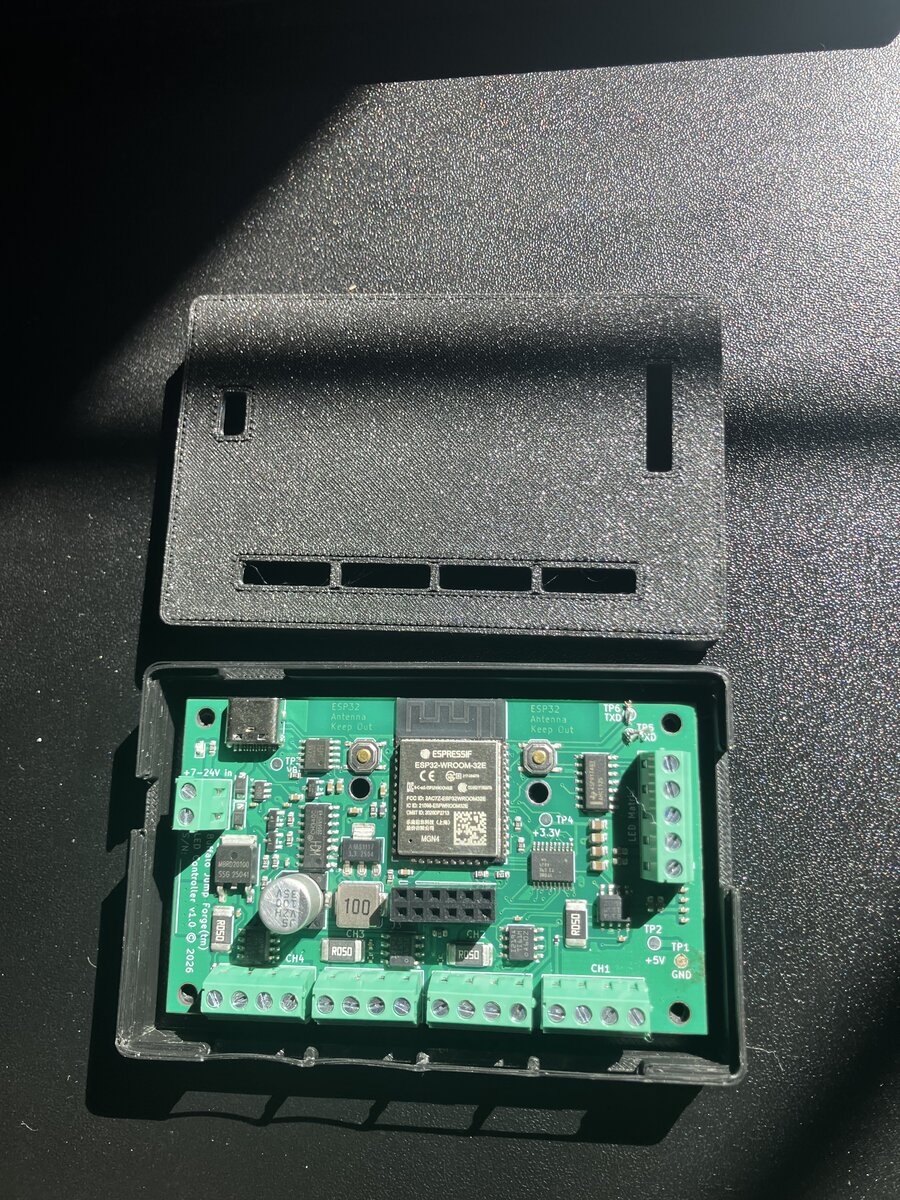
First in a series on building the Buffalo Jump Forge LED Controller from idea to Kickstarter.
Ryan Pedersen and I go back to my Microsoft days. We’ve been tinkering with LED strips for years — longer than either of us would probably admit. The problem we kept running into was always the same: we wanted to run a lot of lights, outdoors, simply. Nothing on the market did that well. The controllers were either underpowered, overcomplicated, or designed for indoor hobby use and not built to survive a Montana winter.
So that was sitting on the back burner for a while.
Then my kid Hannah mentioned something offhand about their frustration while driving. The ambiguity of hand gestures — the wave that means “thank you” and the wave that means something else entirely (depending on context, we’re talking about NYC here). They said they wished they had a sign in their car to communicate with other drivers…in all the ways, including legal.
I’m building that. LED matrix panels driven by MAX7219 chips, mounted in a car window, controlled from a phone. Which meant I now had two separate hardware problems: the outdoor LED strip controller Ryan and I had been sketching, and a compact matrix sign controller for Hannah’s commute sign.
One board that could drive both addressable LED strips and MAX7219 matrix panels, if designed correctly. One BOM, but more complicated, and opening up an interesting Kickstarter question: one campaign with a lot of add-ons, or two campaigns with common hardware underneath.
Before I touched a schematic, I wanted to know what the market looked like and where it came up short — and I wanted to test how well AI could do that work. Doing it properly means significant effort on Reddit, Discord, and Amazon. This is exactly the kind of problem AI can take off my plate.
What I asked it to do
I gave it both use cases — WLED-compatible LED strip control and MAX7219 matrix panel control — and asked it to map the top competitors across both, then run a SWOT (strengths, weaknesses, opportunities, threats) analysis to find the gaps. Not features competitors had. Features none of them had. Ranked by potential demand.
The landscape came back in tiers: commodity ESP32 boards at $8–15, community favorites like Athom at $15–35, prosumer options like the QuinLED Dig-Quad at $40–50, and commercial products above that.
Clearly there was a gap in the “prosumer” market, where you want to do real things with LEDs, but not hire commercial installers.
What it found
The top-ranked gap was something Ryan and I had talked about before: how much power is available, being used, or needed for my installation?
Not one WLED controller — $8 knockoff or $50 QuinLED — ships with current monitoring. Every controller on the market runs blind. No per-channel current data. No protection if a strip faults. No way to diagnose why a PSU is running hot or why an installation is flickering. The WLED community has 50,000+ active users and they’ve been working around this with inline meters and manual math for years.
What’s the market doing? Cobbling together makeshift solutions with meters, probes and duct tape.
(Since I started this project, Athom has released a controller with total power monitoring — which validates the gap. Per-channel monitoring, which is what actually tells you which strip is pulling too much, is still missing.)
The LED controller market is $3.2B today and growing at 10.5% annually — it’ll hit $8.1B by 2033. The WLED community is a small, organized, vocal, and technically sophisticated slice of that. They’re exactly the kind of early adopters who support a Kickstarter and tell their friends about it.
The rest of the gap list supported jumping into action: 1. better multi-voltage support, 2. hardware-level overcurrent protection, 3. unified strip-and-matrix control — but the current monitoring gap was the one with the most demand behind it and no existing answer.
Where it’s going
The Buffalo Jump Forge LED Controller is built around that gap. Four independent channels, an INA219 current sensor on each one, real-time power data surfaced natively into WLED via a custom usermod, 5V through 24V support, hardware overcurrent detection, NTC thermal monitoring.
My third revision of prototypes are headed to me now (stay tuned for details on how AI does helping build hardware).
The Kickstarter is planned for Q3 2026, after some community building in the WLED ecosystem.
What I learned
I used AI to investigate and validate my intuition — that there is a market gap in the LED controller space I might be able to fill. It wasn’t a “once and done” process — I did the initial research in one session, reflected on how that went, what questions I asked and what I should have asked, and how I might make this a repeatable skill or capability in my AI infrastructure (see: memento). Then I did it again. And again. Probably five sessions total, pushing and questioning, taking different angles (critic, researcher, product owner, skeptic) to try and uncover all the gaps I could. Once I had enough signal, I started designing.
Hopefully, I can ship that sign to Hannah in the next few months and they can give all their commuter acquaintances that big “thumbs up!” — it’ll be up to them to decide if it’s genuine or sarcastic!
Next in this series: hardware design decisions and why per-channel current monitoring is harder than it sounds.
Follow along: This is the first post in a series that’ll run through prototyping, community building, and the Kickstarter campaign itself. If you want to keep up, follow me on LinkedIn or subscribe to this blog — I post when there’s something worth saying, not on a schedule.
Support this work: The best thing you can do right now is share this post with anyone building with LEDs, running a large WLED installation, or interested in what AI-assisted hardware development actually looks like in practice. When the Kickstarter launches, backing early and spreading the word is what makes these campaigns succeed. I’ll post the link here when it’s live.